
The leak detector that finds what everything else misses.
The DXH-240 locates micro-leaks in automotive A/C systems, HVAC and refrigeration coils, and EV battery enclosures — using a safe, non-flammable hydrogen tracer gas that escapes through openings other methods miss.
A smaller molecule finds a smaller hole.
Hydrogen is the smallest, lightest molecule available for tracer gas work, so it escapes through openings that refrigerant, UV dye, and soap bubbles never reach. Mixed to a non-flammable 5% hydrogen / 95% nitrogen blend, it’s safe to use in occupied bays and on live production lines — with no refrigerant vented to the atmosphere while you search.
| Detection method | Typical minimum leak resolved | Refrigerant loss equivalent | DXH-240 sensitivity advantage |
|---|---|---|---|
| Soap bubble test | ~1×10⁻² cc/s | ~100 oz/yr | 1,000× more sensitive |
| UV dye | Visual only — no rate | Not quantifiable | Not quantifiable |
| Standard refrigerant sniffer | ~1×10⁻⁴ cc/s | ~1 oz/yr | 10× more sensitive |
| DXH-240 (H2/N2 tracer mode) | 1×10⁻⁵ cc/s | ~0.10 oz/yr | Reference |
Soap-and-water testing only catches leaks down to around 100 oz/yr, and a standard refrigerant sniffer stops at around 1 oz/yr. The DXH-240 finds leaks as small as 0.10 oz/yr — ten to a thousand times smaller. Systems that “pass” a soap-bubble or sniffer check can still be leaking well under those thresholds, which is why products tested only with those coarser methods most often go on to show refrigerant loss and related breakdowns within the first year of operation.
Built for the bay, the rooftop, and the production line.
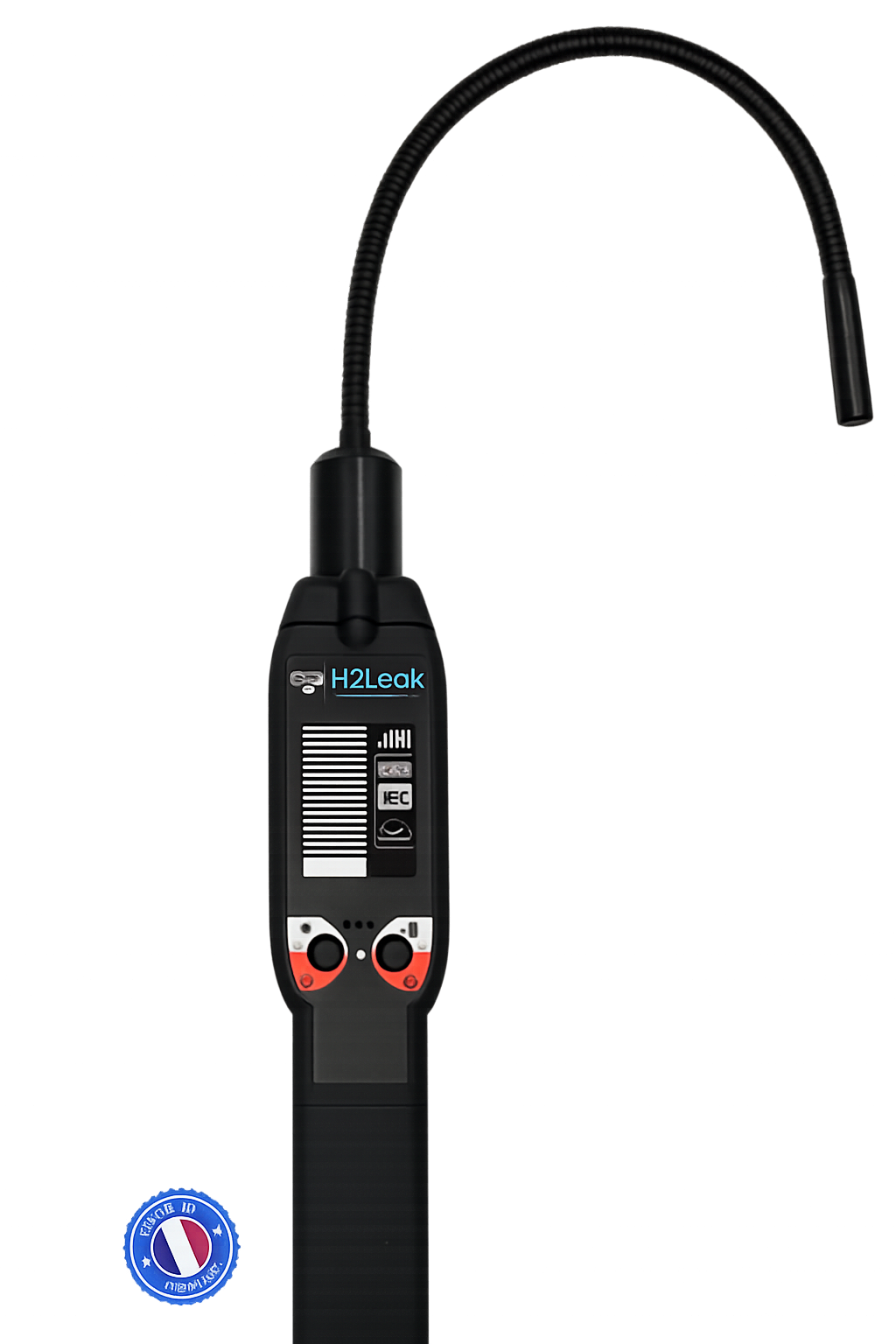
A hand-held leak detector used for tightness control by sniffing at atmospheric pressure. Designed for worksite and maintenance applications, with wear parts — the detection cell and flexible suction pipe — directly interchangeable for easy upkeep, and maintenance and spare parts readily available.
- High-sensitivity electrochemical detection cell for H₂/N₂ tracer gas
- 30 cm flexible probe with steel shape memory and interchangeable filter tip
- Two detection modes: DETECTION (auto zero) and TRACK (manual zero)
- 4-position sensitivity selector with progressive OLED graphic ramp and sound signal
- Lighting LED at the probe tip for dark detection areas
- Field-interchangeable wear parts: detection cell and suction pipe
| Housing | Shockproof plastic case · Height 55 cm · Width 5 cm · Depth 4 cm · Weight 0.35 kg |
|---|---|
| Power supply | Built-in rechargeable battery, ~8h autonomy · USB-C charging, full charge in ~12 hours |
| Uses | Worksite and maintenance applications · Optimal performance 10–40°C |
| Detection |
|
| Warm-up time | ~60 seconds (cell heating) |
| Response time | ~1 second |
| Sensitivity |
|
| Calibration | Automatic zero on ambient atmosphere · 4 sensitivity positions |
| Display | Progressive graphic ramp with sound signal · battery level and ambient contamination indication · permanent self-monitoring for cell error and low battery |
| Carrying case | Supplied complete in transport case with charger and user manual |
| Origin / support | CE marked · maintenance and spare parts readily available |
| Warranty | 12 months |
Application, conception, and maintenance.
Built for worksite reliability: wear parts are directly interchangeable, and maintenance and spare parts come straight from the manufacturer.
Application
- Hand-held detector for tightness control applications
- High-performance sensor for H₂/N₂ tracer gas
- Detects leaks by sniffing at atmospheric pressure
Conception
- Mode selector: DETECTION (auto zero) or TRACK (manual zero)
- 4-position sensitivity selector
- Progressive graphic ramp with sound signal
- Lighting LED at the head of the probe
- Interchangeable detection cell and flexible suction pipe
Maintenance
- Maintenance and spare parts supplied directly by the manufacturer
- Wear parts swap out without sending the unit in
- Optional protective cover shields the case and improves handling
How a DXH-240 leak check runs, start to finish.
The same core sequence applies whether you’re chasing a rooftop condenser leak, an automotive A/C joint, or a cell in an EV battery pack.
Reclaim
Recover any existing refrigerant from the system before introducing tracer gas.
Pressurize
Charge the coil, line, or enclosure with the non-flammable 5/95 H₂/N₂ mix.
Sweep
Move the sniffer tip within 1/4″ of each joint at roughly 1 inch per second.
Narrow in
Start on the most sensitive setting, then step down to isolate the exact point.
Confirm
Mark and verify the leak location before opening the system for repair.
Recheck
After repair, re-test the same joint and sweep the rest of the system for others.
One detector, four service jobs.
Every application below uses the same 5/95 hydrogen tracer gas and the same DXH-240 — only the system geometry and the leak points you’re chasing change.
Automotive A/C Leak Detection
Chase R134a and R1234yf system leaks at compressor seals, hose crimps, and condenser joints without venting refrigerant or waiting on UV dye to migrate.
- Compressor shaft seals and manifold fittings
- Condenser and evaporator brazed joints
- Hose crimps and O-ring connections
HVAC System Leak Detection
Find slow refrigerant loss in rooftop units, split systems, and long line-set runs — leaks that show up as an under-charged system months later.
- Evaporator and condenser coil brazes
- Line-set flare and Schrader connections
- Reversing valve and TXV fittings
Refrigeration System Leak Detection
Pinpoint leaks in walk-in coolers, display cases, and rack systems where continuous product loss and food-safety risk make slow leaks expensive. Catching leaks at the 0.10 oz/yr level also supports compliance with EPA refrigerant management rules and the EPA GreenChill Advanced Refrigeration Partnership, both of which push supermarkets and cold-storage operators toward lower annual refrigerant loss rates.
- Case evaporator coils and drain lines
- Rack manifold and header joints
- Compressor room fittings and valves
- Supports EPA and GreenChill refrigerant-loss reduction goals
EV Battery Leak Detection
Test welded seams, gasketed lids, and cooling-circuit connections on battery packs, where a compromised seal risks coolant loss, corrosion, or thermal events.
- Enclosure welds and gasketed lid seams
- Cooling-plate and thermal-loop fittings
- Module and cell-level end-of-line testing
Common questions on hydrogen tracer gas detection.
What tracer gas does the DXH-240 use?
A non-flammable mixture of 5% hydrogen and 95% nitrogen, often called forming gas or 5/95 tracer gas. Because it’s below hydrogen’s flammability threshold, it’s safe to use in occupied service bays and production environments.
Is hydrogen tracer gas leak detection safe for automotive A/C service?
Yes. You reclaim the existing refrigerant, pressurize the system with the 5/95 blend, and sniff for leaks at joints and fittings — no refrigerant is vented to the atmosphere during the search itself.
Can a hydrogen leak detector find leaks in EV battery packs?
Yes. Forming gas is a standard tracer for battery enclosures, cooling circuits, and thermal plates, since hydrogen’s small molecular size escapes even micron-level leaks and its low natural background in air keeps false readings low.
Is the DXH-240 safe to use in hazardous or explosive atmospheres?
No. It’s a non-explosion-proof detector and must never be used in hazardous or explosive atmospheres, or at hydrogen concentrations at or above the lower explosive limit (LEL) of 5.7%.
Ready to stop guessing where the leak is?
Get pricing on the DXH-240, or ask which detector fits your application.