

Would you rather lose 60 lb of refrigerant a year per system or less than an ounce?
New supermarket systems are accepted on a 24-hour nitrogen pressure decay test. It catches gross leaks, but the slow leaks it lets through are paid for later, as refrigerant top-ups, service calls and EPA compliance work, for the life of the system.
Based on a typical 10 ft³ rack section. The largest leak a pressure decay test can miss is about 22,000 times larger than the smallest leak a hydrogen tracer detector can find, and the tracer detector shows you which joint it is. See the math.
Typical supermarket’s annual refrigerant loss, per EPA GreenChill.
Refrigerant a typical store leaks each year, per EPA GreenChill.
Temperature swing that uses up the whole 1 psig pass limit at a 300 psig test.
Why the 24-hour decay test isn’t good enough
EPA’s GreenChill installation guideline, mirrored in many chain specs, calls for dry nitrogen at 300 psig or more, held 24 hours, with no more than about a 1 psig drop. It is the predominant acceptance test for new supermarket systems. It has four built-in weaknesses.
Temperature hides leaks
At 300 psig, each 1 °F change in piping temperature shifts the gauge about 0.6 psi. A store under construction can swing several degrees overnight, more than enough to mask a real pressure loss.
The pass limit is wide
A 1 psig allowance on a system holding tens of cubic feet lets several standard cubic feet of nitrogen escape in 24 hours with the test still recorded as a pass.
It measures the whole system at once
Thousands of brazed joints, flare fittings and valve seals share one gauge reading. A handful of slow leaks add up without ever crossing the line.
It doesn’t find anything
The test gives a pass or fail, not a location. Even a failed test sends techs back to soap bubbles, joint by joint. Segment tests during construction are often shorter than 24 hours.
How big a leak can pass the pressure test?
A 1 psi drop over 24 hours means a fixed amount of gas has escaped, set by the volume under test. Here is that leak rate compared with what a hydrogen tracer detector can find.
| Volume under test | Gas lost in 24 h | Leak rate passing a 1 psi / 24 h test | Size vs. 1×10⁻⁵ mbar·L/sec | Refrigerant lost per year |
|---|---|---|---|---|
| 1 ft³ (walk-in or condensing unit) | ~1,950 mbar·L | ~0.023 mbar·L/sec | ~2,300× | ~6 lb |
| 5 ft³ | ~9,800 mbar·L | ~0.11 mbar·L/sec | ~11,000× | ~30 lb |
| 10 ft³ (typical rack section) | ~19,500 mbar·L | ~0.23 mbar·L/sec | ~22,600× | ~60 lb |
| 20 ft³ | ~39,000 mbar·L | ~0.45 mbar·L/sec | ~45,000× | ~125 lb |
| 50 ft³ (large rack and piping) | ~98,000 mbar·L | ~1.1 mbar·L/sec | ~113,000× | ~310 lb |
| Hydrogen tracer detection, any volume | ~0.86 mbar·L | 1×10⁻⁵ mbar·L/sec | 1× | ~0.04 oz |
How one missed leak becomes a recurring expense
A leak that passes commissioning doesn’t go away. Once the system is charged, it starts a sequence the store operator pays for.
- The system passes the 24-hour hold and is chargedThe slow leak is too small for the gauge to show, so it is signed off.
- Refrigerant escapes in operationRefrigerantThe leak now runs at operating pressure, around the clock, for years. Under the HFC phasedown, every pound replaced is getting more expensive.
- A tech tops off the systemServiceEach top-up is a service call, and under EPA’s ER&R rule each refrigerant addition to a system over 15 lb requires a leak-rate calculation and record.
- The leak rate crosses 20%ComplianceCommercial refrigeration above the 20% annual threshold must be repaired within 30 days, with verification testing and, once over the threshold, recurring leak inspections.
- The repair happens in a live storeDisruptionNow fixing the joint means isolating or recovering refrigerant, re-brazing around operating cases, re-testing, evacuating and recharging. Product may have to be moved, and case temperatures are at risk while the work is done.
Undercharged systems also tend to run less efficiently and are more prone to temperature alarms, which adds energy and shrink costs not counted below.
Finding the leak at commissioning
- System is empty: no refrigerant to recover
- Store isn’t open: no product or customers to work around
- The installing contractor is on site and responsible
- Fix is a single re-braze and re-test
Finding it after opening
- Refrigerant already lost, plus recovery and recharge
- Service call, often after hours
- Leak-rate calculations, repair deadlines and records
- Risk to case temperatures and product
- Repeats every year until the leak is found
What the leak rate costs your chain
Enter your chain’s numbers. The example values use the EPA GreenChill typical-store figures for charge and leak rate; the cost inputs are placeholders to replace with your own.
–
Estimates only. Excludes energy, product loss, after-hours premiums and compliance labor, which add to the total. Refrigerant prices are rising under the HFC phasedown.
Add a tracer gas test to the commissioning spec
Keep the 24-hour strength and decay test. Add a joint-by-joint tracer test with a nonflammable 5% hydrogen / 95% nitrogen mixture and an electronic hydrogen detector. Hydrogen is the smallest molecule, air contains only about 0.5 ppm of it, and a sniffer finds leaks far smaller than any pressure gauge can register, at the exact joint. EPA’s GreenChill program notes that leaks can be found at installation by testing with hydrogen or helium before the system is charged.
Sample language for a refrigeration installation spec:
TRACER GAS LEAK TEST After the standing pressure test is complete and before evacuation, the contractor shall pressurize each system or section with a 5% hydrogen / 95% nitrogen tracer gas mixture and test every brazed joint, mechanical fitting, valve and accessible component with an electronic hydrogen leak detector. Any detected leak shall be repaired and the section retested until no leak is indicated. The contractor shall record the date, sections tested, test pressure, detector make and model, and any leaks found and repaired, and include this record in the commissioning documents. The tracer gas shall be vented to atmosphere outdoors before evacuation.Copied
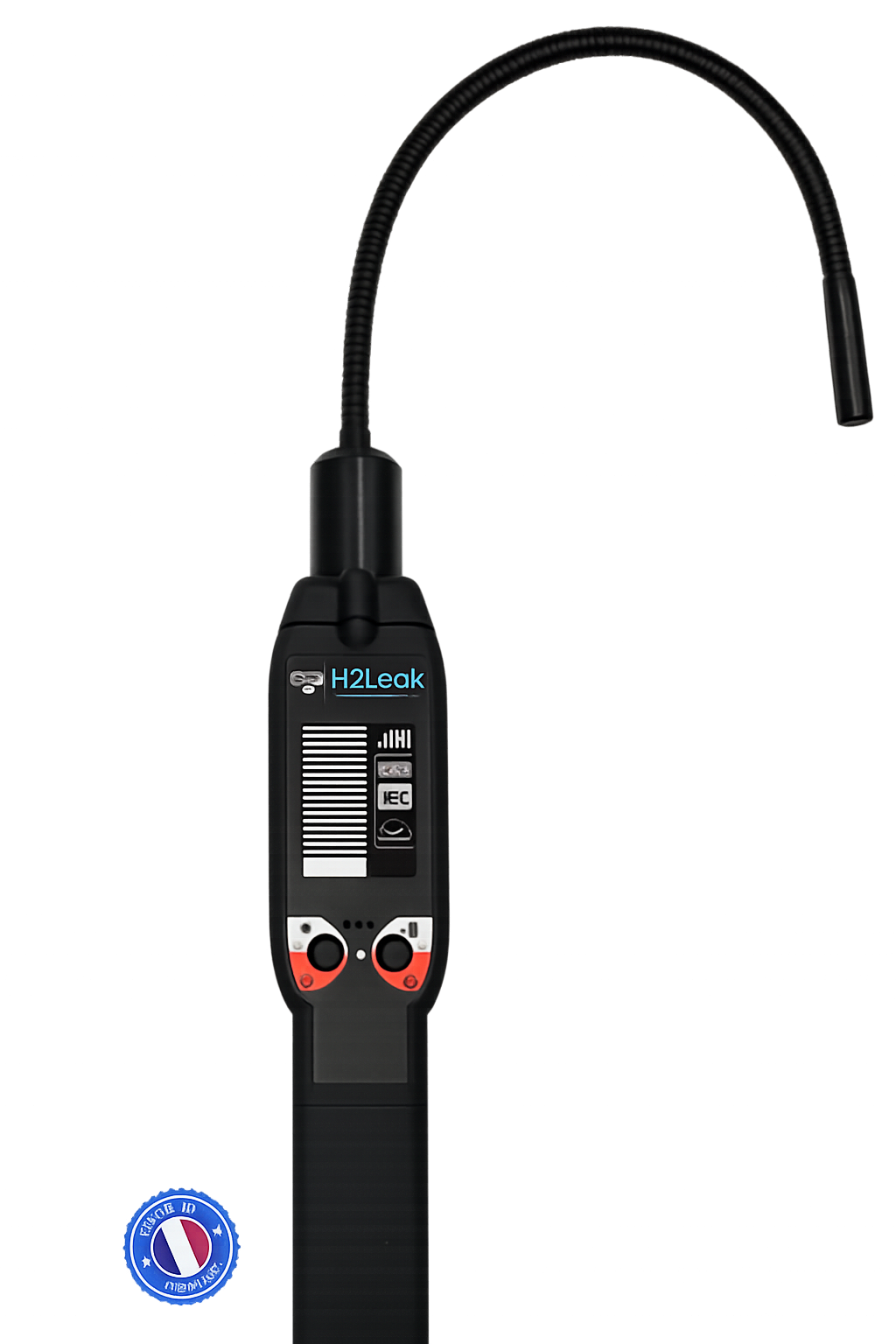
refrigerant and hydrogen leak detector
One detector for tracer gas and refrigerant leaks
The DXR-240 is the detector behind the 1×10⁻⁵ cc/sec figure on this page. It switches between 5% H₂ / 95% N₂ tracer gas for new piping before charging and direct refrigerant detection for charged, operating systems.
- Leak-check new racks before chargingFind leaks at 1×10⁻⁵ cc/sec, about 1 g/yr refrigerant equivalent, joint by joint, during commissioning.
- Then service the same system chargedDetects HFC, HFO and hydrocarbon refrigerants including R290 and R600, down to 1 g/yr.
- Lower-cost test gasHydrogen tracer gas costs roughly a fourth to a fifth as much as helium, and it is nonflammable and non-toxic, so it vents instead of being recovered.
- Built for the job siteFast 1-second response, shockproof case, LED work light, 8-hour battery with USB-C charging, and a 350 g weight.
- A service contractors can sellOffer tightness testing for commissioning and EPA and GreenChill compliance, and cut callbacks.
DXR-240 specifications
- H₂/N₂ tracer sensitivity
- 1×10⁻⁵ cc/sec minimum (≈ 1 g/yr refrigerant)
- Refrigerant sensitivity
- 1 g/yr minimum: HFC, HFO, R290, R600
- Gases detected
- HFC, HFO, HC and 5% H₂ / 95% N₂
- Sensitivity settings
- HI, MED, LO
- Detection cell
- Interchangeable: universal (refrigerants + H₂/N₂) or selective (H₂/N₂ only)
- Response time
- About 1 second
- Warm-up
- About 60 seconds
- Calibration
- Automatic calibration and zeroing to ambient air
- Probe
- 30 cm flexible, steel shape memory, suction flow
- Display and alarm
- OLED with graphic ramp, rising tone, battery and contamination indicators
- Lighting
- LED work light at the tip of the housing
- Battery
- Built-in rechargeable, about 8 hours; USB-C charging
- Weight
- 0.350 kg
- Operating temperature
- 10–40 °C (50–104 °F)
- Included
- Detector, transport case, mains charger, user manual
- Safety
- Not explosion-proof; do not use in hazardous atmospheres
Stop paying for leaks that passed inspection
H2Leak supplies hydrogen leak detectors and can help your contractors add tracer gas testing to new store commissioning.
www.h2leak.com