
Hydrogen tracer gas leak detection
Hydrogen Leak Detectors for Tracer Gas Leak Detection
A hydrogen leak detector paired with a safe 5% hydrogen / 95% nitrogen tracer gas finds leaks that soap bubbles, UV dye and ordinary refrigerant sniffers miss — in HVAC and refrigeration systems, automotive A/C, and buried water, pool and gas piping. H2Leak has supplied hydrogen tracer gas leak detectors to service technicians, plumbers and leak-detection companies across the USA since 2007.
What is a hydrogen leak detector?
A hydrogen leak detector is a handheld or probe-based instrument with a sensor that responds to very small concentrations of hydrogen gas in the air. In tracer gas leak detection, a system is filled with a harmless mixture of 5% hydrogen and 95% nitrogen, and the detector “sniffs” for hydrogen escaping through a leak. The closer the probe gets to the leak, the stronger the reading and the faster the audible tone — so the technician can follow the signal straight to the exact leak point.
It’s worth separating two kinds of products that share the name:
Tracer gas leak detectors
Portable, highly sensitive instruments used to locate leaks in pipes, coils, fittings and sealed components. The hydrogen is deliberately introduced as a tracer, at a non-flammable 5/95 concentration.
Hydrogen safety gas detectors
Fixed or personal monitors that alarm when hydrogen builds up to unsafe levels around fuel cells, battery rooms or hydrogen fuel systems. They protect people, but they aren’t built to pinpoint the source of a tiny leak.
How hydrogen tracer gas leak detection works
Hydrogen tracer gas leak detection is simple in principle: put a gas that is easy to detect inside the system, then search the outside of the system for it.
- Fill: The empty system — a refrigerant circuit, a water line, a pool return — is pressurized with 5% H₂ / 95% N₂, often called forming gas. It’s stocked by most industrial and welding gas suppliers.
- Escape: Hydrogen is the smallest, lightest molecule there is, so it moves out through leak paths quickly — even through gaps too small for refrigerant, dye or water to reveal.
- Detect: The detector’s sensor picks up the hydrogen escaping at the leak. Because normal air holds only a trace of hydrogen (roughly half a part per million), even a small rise stands out against the background.
- Locate: A graduated display and rising tone lead you in. Most H2Leak detectors have adjustable sensitivity so you can scan broadly, then dial down to the precise point.
Underground, the same principle works through soil, asphalt and concrete. Hydrogen rises straight up from a buried leak, so a ground probe can locate it at the surface — often without any excavation until you know exactly where to dig.
Why use hydrogen for leak detection?
Finds smaller leaks
A small molecule escapes through small holes. Hydrogen tracer detection resolves leaks far below what soap bubbles or a standard refrigerant sniffer can see.
Pinpoints location
Low natural background and fast dispersal mean a sharp, local signal — so you repair the right joint or dig in the right spot the first time.
Safe and non-flammable
At 5% hydrogen in nitrogen, the tracer mix is non-flammable, non-toxic and non-corrosive, and suitable for drinking-water piping.
Lower cost than helium
Forming gas is widely available and typically far cheaper than helium, which has faced repeated price spikes and supply shortages.
No refrigerant vented
Searching with tracer gas instead of refrigerant means nothing harmful is released while you hunt for the leak.
Works where acoustics fail
Plastic pipe, low pressure and deep or noisy sites can defeat acoustic leak detection. Tracer gas doesn’t depend on leak noise.
Hydrogen vs. helium vs. other leak detection methods
Every leak detection method has a floor: the smallest leak it can reliably find. Anything below that floor gets signed off as “tight” even though it’s still losing gas.
| Method | Typical smallest leak found | Approx. refrigerant-loss equivalent | Notes |
|---|---|---|---|
| Soap bubble test | ~1×10⁻² cc/s | ~100 oz/yr | Cheap, but only catches large leaks |
| UV dye | Visual only | Not measurable | Needs time to migrate; no leak rate |
| Standard refrigerant sniffer | ~1×10⁻⁴ cc/s | ~1 oz/yr | System must be charged with refrigerant |
| Hydrogen tracer gas (DXH-240) | 1×10⁻⁵ cc/s | ~0.10 oz/yr | Safe 5/95 mix; low cost; pinpoints location |
| Helium tracer gas (TG-240D) | 1×10⁻⁵ cc/s | Comparable to hydrogen | Inert; higher gas cost; good for labs and specialty work |
For a deeper look, see our comparison of leak detection tracer gases and technologies.
Where hydrogen leak detectors are used
HVAC & refrigeration service
Find the slow leaks behind under-charged rooftop units, split systems and heat pumps: coil brazes, line-set flares, Schrader cores, TXV and reversing-valve fittings. Recover, charge with tracer, locate, repair and verify.
Supermarket & commercial refrigeration
Rack systems, walk-ins and display cases lose product and margin to slow leaks. Finding leaks at very low rates helps operators meet EPA refrigerant management requirements and GreenChill leak-reduction goals.
Automotive A/C
Locate R-134a and R-1234yf leaks at compressor seals, hose crimps and condenser joints while the vehicle is still on the lift — no waiting days for dye to appear.
Underground water & gas lines
Plumbers, leak-detection companies and municipal water departments use hydrogen to locate buried leaks through soil, asphalt and concrete, including plastic pipe where acoustic methods struggle.
Swimming pool piping
Trace leaks in pool return, suction and skimmer lines under decks and slabs, so you open the deck in one place instead of several.
Manufacturing & other systems
End-of-line tightness checks on HVAC/R components, EV battery enclosures and cooling plates, pipelines and other sealed systems.
Choosing the right hydrogen leak detector
All H2Leak detectors share the same core approach — a sensitive hydrogen sensor, a graduated display and a rising alert tone. The right model depends on the work you do.
 Underground
Hydro-Lok™
Built for buried water, pool and gas piping. Cone and pinpoint tips read through soil, asphalt and concrete; field-replaceable hose and sensor.
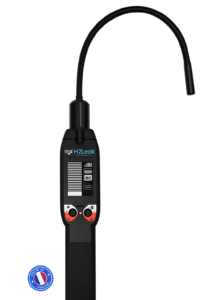
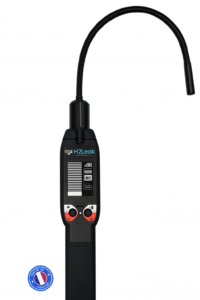 HVAC · Auto · EV
DXH-240
Our most sensitive handheld hydrogen leak detector: 1–1,000 ppm H₂, 1×10⁻⁵ cc/s, DETECTION and TRACK modes, LED probe light, USB-C charging.
 Dual gas
DXR-240
Hydrogen tracer gas and direct refrigerant detection in one unit, so you can check charged systems or switch to tracer gas as the job requires.
 Entry level
TLD.500
Our original hydrogen sniffer in a streamlined, lower-cost package for HVAC, automotive and general-purpose leak detection.
TG-240D
Thermal-conductivity detection for helium, hydrogen, argon, CO₂, SF₆, methane and refrigerants — for labs and specialized industrial work.
Quick guide
- Buried pipe or pools → Hydro-Lok
- Highest handheld sensitivity → DXH-240
- Need refrigerant sniffing too → DXR-240
- Budget-friendly → TLD.500
- Helium or other gases → TG-240D
How to run a hydrogen leak test
The same basic sequence applies to a rooftop condenser, an automotive A/C joint or a battery enclosure:
- Recover. Recover any refrigerant in the system before introducing tracer gas.
- Pressurize. Fill the system with 5% H₂ / 95% N₂, staying within the equipment’s rated test pressure.
- Sweep. Move the probe tip about ¼″ from each joint at roughly one inch per second.
- Narrow in. Start on the most sensitive setting, then step down to isolate the exact point.
- Confirm. Mark and re-verify the location before opening the system.
- Re-test. After the repair, check the same joint again and sweep the rest of the system.
For buried lines, pressurize the isolated section with tracer gas, give it time to migrate to the surface, then work the ground probe along the pipe route — on bare soil, through cracks and expansion joints, or through small bar holes in hard surfaces.
Is hydrogen leak detection safe?
Yes, when done with the right gas and equipment. The standard 5% hydrogen / 95% nitrogen tracer mix is classified as non-flammable, and it’s non-toxic and non-corrosive. That is why it’s used in occupied service bays, on production lines and in drinking-water lines.
Important: H2Leak handheld detectors are not explosion-proof. Use only the 5/95 tracer mixture — never pure hydrogen — and never use the detectors in hazardous or explosive atmospheres. Always follow the system’s rated test pressure and your gas supplier’s handling guidance.
Hydrogen leak detector FAQ
What does a hydrogen leak detector do?
It senses very small amounts of hydrogen in the air. In tracer gas leak detection, a system is filled with a 5% hydrogen / 95% nitrogen mix and the detector follows the hydrogen escaping from a leak to its exact location.
How sensitive is a hydrogen leak detector?
The H2Leak DXH-240 reads from 1 to 1,000 ppm hydrogen and resolves leaks down to 1×10⁻⁵ cc/s with tracer gas — roughly 0.10 oz/yr of refrigerant. That is about ten times finer than a standard refrigerant sniffer and about a thousand times finer than a soap-bubble test.
Is 5% hydrogen / 95% nitrogen tracer gas flammable?
No. At 5% hydrogen in nitrogen, the mixture is classified as non-flammable, which is why it’s the industry-standard tracer blend. Pure hydrogen should never be used for leak testing.
Where can I buy hydrogen tracer gas?
Most industrial and welding gas suppliers stock it. Ask for 5% hydrogen / 95% nitrogen (also called forming gas) and use a regulator rated for your test pressure.
Is hydrogen better than helium for leak detection?
For most field service work, yes. Both find very small leaks, but hydrogen tracer gas is usually much less expensive and more readily available, and normal air contains less hydrogen than helium, which helps keep readings clean. Helium remains useful for labs and some specialized applications.
Can a hydrogen leak detector find underground water leaks?
Yes. Hydrogen rises through soil, asphalt and concrete, so a ground probe such as the Hydro-Lok can locate a buried leak from the surface — including leaks in plastic pipe or low-pressure lines where acoustic equipment struggles.
Can I use a hydrogen leak detector on a system charged with refrigerant?
Hydrogen-only detectors need the tracer gas in the system. If you want to check systems that are still charged with refrigerant, the DXR-240 combines direct refrigerant detection with hydrogen tracer detection in one unit.
Is a hydrogen leak detector the same as a hydrogen gas safety monitor?
No. A safety monitor alarms when hydrogen builds up to dangerous levels around fuel cells or battery rooms. A tracer gas hydrogen leak detector is a sensitive locating tool used to find the exact source of small leaks.
Find your next leak faster
Tell us what you service — HVAC, refrigeration, automotive A/C, underground pipe or pools — and we’ll recommend the right hydrogen leak detector for the job.
H2Leak · 233 Arnold Mill Road, Suite 300, Woodstock, GA 30188 · 770-479-7138